Friday, October 30, 2015

Trouble in Paradise - Intag

The Ecuadorian villiage of Pucará is a solid candidate for the title of World's Most Unassuming Place.  It's a humble little town, small in every sense, with modest buildings dwarfed even further by the Andean monoliths that pierce the horizon in every direction.  The center square, complete with a small church, two stores, and a volleyball court, branches out into a few sleepy streets, ranging out in different directions towards family farms and friendly bungalows.  The dirt highway, old but rarely used, rolls haphazardly through the middle of it all; trucks and buses rumble by semi-regularly, pushing onward to bigger and busier destinations as locals chat nonchalantly outside.

Pucará has never really tried to attract much attention to itself. It's a reserved place, even by Ecuadorian standards; by American ones, it would qualify as ¨extremely quiet.¨ But after spending some time in the villiage, an outsider will discover a new-age vitality that's hard to come by elsewhere in the rural Andes. Off the square, for example, there's a Spanish school where local women can earn money by teaching tourists and backpackers their language.  A shiny new Community Center, officially the largest building in the entire Intag Watershed, fosters a close and communicative local network.  Close by is the Rio Intag Coffee Cooperative, a regional coalition of growers who together produce some of the world's most delicious - and critically acclaimed - coffee. Residents run a restaurant, selling only the freshest of sustainably grown local goods; there's also a handbag weaving business that exports to two other continents.  Although fewer than 250 people call Pucará home, the area's energy and industry are suggestive of a much larger place.

Our ten days in town were some of the fullest and most eye-opening yet.  We worked closely with Peter Shear, an American expat living in Pucará who has devoted his last 20 years to developing the community. We spent the week working for the residents, exploring the region, studying sustainable agriculture, and learning about the pressing socio-political issues of the region.

Things aren't looking good for Pucará.  The villiage is in the midst of a decades-long conflict that threatens to uproot the entire community and destroy the local way of life. The Intag Watershed, where Pucará is located, sits atop one of the largest unexcavated copper deposits in the world; it also happens to be among the planet's most biodiverse regions, with more species per hectare than almost anywhere.  Excavating and refining the copper would swiftly reduce the entire watershed to a barren wasteland, thereby eliminating one of the last great natural paradises and displacing thousands of natives, including the citizens of Pucará and similar villiages.  International companies have been jostling for the rights to the copper deposit since 1996, while the Ecuadorian government has sat passively by. Supported by only their own industry and determination, the locals have succeeded in preserving their land, fending off powerful corporate giants from Japan, Chile, and Canada. Recently, however, pressed by a growing national debt, the Ecuadorian government has begun an effort to sieze the land for itself. Locals and outsiders alike view this as traitorous; it also goes against several constitutional laws.

Our role in the conflict was a small one: To learn what we could about these problems, and then dedicate just a few days of our time and energy to the community. We saw firsthand that Pucará's best bet is a stronger, more self-reliant Pucará; our task, then, was simply to support the town.

So we stayed awhile.  We ate at the restaurant, bought some handbags, and paid host families for room and board.  We spent a few mornings plowing fields and planting pineapples with and for some of the local farming families. We hiked (and, in one case, ziplined) all over the place, absorbing the scenery and experiencing the Cloud Forest while it still exists. We chatted with locals. We salsa'd with our host moms in the square.  We got absolutely decimated by the local soccer team - although we let them win, obviously, because that's the charitable thing to do, of course. And it's safe to say that we had a truly unforgettable exrpeience.

Places like Pucará are a dying breed. Life in the 21st Century has become so hurried and competitive that even the most rural communities are endangered by the pressures of the modern area - to the detriment of their cultures and against their collective wills. But Pucará is fighting back. The times have galvanized the people into action, and they're all working, with some success, to preserve their heritage and their home. We were extremely fortunate to have the opportunity to experience their way of life. Hopefully, it will remain for years to come.

There are no guarantees, however; the people of Intag are fighting an uphill battle.  Money, of course, is what's lacking. There's truly no better place to put your spare change - dollars go a long way in Ecuador, and every cent counts in this fight.  Visit http://www.decoin.org/ to donate or to learn more.

*Actually not Pucará, but a similar-ish villiage near Otavalo, since I forgot to take pictures of the town

A slice of the Intag Watershed.  Can't capture it with a camera
SpongeBob?

Awesome tourist cabins where we stayed our last two nights, near the villiage of Junín (population: 36) - another example of Intag's industry


Monday, October 12, 2015

Welcome to the Jungle - Tena/Otavalo

We spent four days of last week in the Ecuadorian Amazon, 30 bumpy minutes outside of the city of Tena, learning how much life can improve when you're half an hour from the nearest power outlet and surrounded by deet-hungry mosquitoes.  Special thanks to my anti-malarial tablets for making this awesome stay possible.

We bunked down in a ridiculously cool two-story shack that our backpacker-friendly host family had constructed in the middle of the jungle.  Reaching the encampment from the dirt road required knee-high rubber boots and a 10-minute trek, which turned out to be a lot more awesome than inconvenient. Overlooking the Napo River, a famous rafting destination, the shack served as our base of operations as we spent the week adventuring through the rainforest and brushing up a little more on our Spanish.

I don't know what to write about first.  The waterfall hike? The laguna hike? The second iteration of the aforementioned waterfall hike, in which we free-rappelled down the same 25-foot cascadas that we had climbed up twice before? The mind-blowing night skies, the likes of which can only be seen numerous kilometers from civilization? The afternoon that we spent panning for gold in the river - with some actual success? Maybe the morning riverside yoga sessions, or the nighttime campfire jams? What about the fact that our amazing host family cooked us native Ecuadorian cuisine all week, serving it up hot and fresh right outside our shack? Or the fact that we're even here at all, instead of in math class or something? It's a challege to keep track of everything, and even harder to do it justice in words.  So many experiences, so much gratitude, and such a short time.  I can't believe it all went by in four days.

Unfortunately, though, it did - which would suck, except we're now in the bustling tourist hub of Otavalo.  We're here for three nights, and it happens to be a blast here as well.  We arrived on Saturday morning, settled into our hostel (has running water AND electricity), and struck out to explore the famous outdoor market.  It's a really cool scene, and our haggling skills are getting sharper all the time.  Most of us, if we hadn't already, bought ourselves ponchos made of llama wool. We'd look exactly like an indigenous tribe if we didn't look so much like tourists.

Today we taxi'd/hiked up to a famous tree, El Lechero.  It supposedly has healing powers; it definitely looks like it has healing powers; if these bug bites stop itching any time soon, I'll be inclined to believe that it does, in fact, have healing powers. It was a great way to spend the morning, healing powers or not, and we followed it up the right way: with a stop at a nearby bakery.

In Ecuador, a dollar can buy two generous slices of cake.  There are some American stereotypes that we're more than happy to uphold.

The back yard


Oh, hey there.


(Yo, also, everybody should check out my buddy Lucas' blog at https://doslenguasdosalmas.wordpress.com/ .  For more blogs written by Carpe Diem kids, doing cool stuff in other parts of the world, go to https://www.carpediemeducation.org/blog/ .)

More pictures to follow, when I can find a fast enough internet cafe.

Sunday, October 4, 2015

Chasing Waterfalls - Baños

It´s almost a challenge to describe the Ecuadorian town of Baños without sounding like a travel brochure.  The place has everything a tourist (or a roving band of student-volunteers) could wish for: a friendly atmosphere, fantastic food, plenty of nightlife, and a picturesque mountain range, which rises up majestically on every side and boasts something like 65 waterfalls.  The outdoor scene, as you might imagine, is off the charts - but the biggest draw of all is probably the series of volcanic hot springs for which the town is named.  This week we´ve encountered other non-locals - mostly European backpackers, actually - for pretty much the first time since Quito, and it´s not too tough to understand why they´re here.

I spent the week living with my buddy Peter - Pedro, I mean - under the roof of a friendly and welcoming host family.  The first of several homestay families on the trip, the Iglesiases set a pretty hard-to-match precedent: They showed us around town when we arrived, cooked us amazing meals all week, and washed our clothes at the laundromat that they run on the roof (an extremely helpful service after a week on a banana farm).  They were remarkably accommodating, and we were blown away by their willingness to take us into their day-to-day lives.

When we weren´t sleeping, eating, or retrieving laundry, though, we were usually out taking advantage of our time in Baños.  Our full schedule was comprised of almost equal parts learning, volunteering, and exploring.

We spent our mornings at a small Spanish school down the street, sharpening our Spanish with a dedicated group of teachers - including, but not limited to, some of our Las Delicias hosts from last week.  Our Spanish skills are improving in leaps and bounds.  For me, basic strings of words are starting to become more intuitive, and I´m starting to understand what it means to think in another language.

We would head home each day at lunchtime to eat with the Iglesias clan, and then return to school afterward for more classes  -  but, this time around, we were the teachers.  Levi and I were tasked with teaching elementary English to a small class of 13-16 year olds, none of whom had more than a year´s worth of English instruction under their belts.  It was a lot more difficult than I had anticipated. Our Spanish skills and creativity were taxed to the extreme, but by the end of the week we had made a pretty successful foray into the ins and outs of present tense verbs. On the last day, our students bought us a cake and asked for our email addresses. Incredibly gratifying.

We were extremely productive during the days, and exremely active during evenings and weekends. Additional accomplishments of the week include, but are not limited to: Rafting through a jungle, summiting a mountain, climbing a waterfall, salsa-ing in a nightclub, filming a music video (more on this later), running to the hot springs, and stumbling upon a good American-style burger joint.  Overall, the week couldn´t have been better.


¨Spanish Jenga¨

I can´t remember what this fruit is called, but it´s delicious.
It´s the thought that counts.

Tuesday, September 29, 2015

Bananas and Hammocks - Las Delicias

I spent the last week living with my Carpe group in the Ecuadorian town of Las Delicias.  That is, if you can call Las Delicias a town.

To the uncultured American observer, Las Delicias is an altogether unfamiliar type of establishment. It´s a semi-official conglomerate of farms and residences, clumped loosely around a couple of stores and a homely futbol court. A quick Google search doesn´t turn up anything definitive, but I guess we can go ahead and use the word ¨town.¨

It´s not actually too important; we spent the whole week on one farm anyway.

For me, the experience was mind-blowing even before it started. The three-hour drive from Quito to Las Delicias, from the Ecuadorian Highlands to the coastal region, was a striking back-and-forth of decrepit rural shantytowns and breathtaking natural scenery. If the view from the bus window wasn´t immensely humbling and somewhat sad, it was knock-your-socks-off, desktop-background-material gorgeous.  I registered a wider range of emotions from that (extremely uncomfortable) bus seat than I ever would have thought possible.  Hadn´t really seen it coming.

We were dropped off about half a mile from the farmhouse, and carried most of our week´s supply of drinking water the remaining distance. I guess the bus driver didn´t feel up to the hike.

Upon arrival, our group was greeted enthusiastically by our first host family, the owners and residents of the farm - which exports mostly bananas, plantains, and cacao.  Our hosts were genuinely excited to have us, even though our Spanish was mostly poor and their English is almost nonexistent.  They showed us around the complex, introduced us to our accomodations, and gave us a slow, clear, and infinitely patient Spanish rundown of the farming process.  My mosquito net bed fort was cozy as all get-out, and I felt right at home.

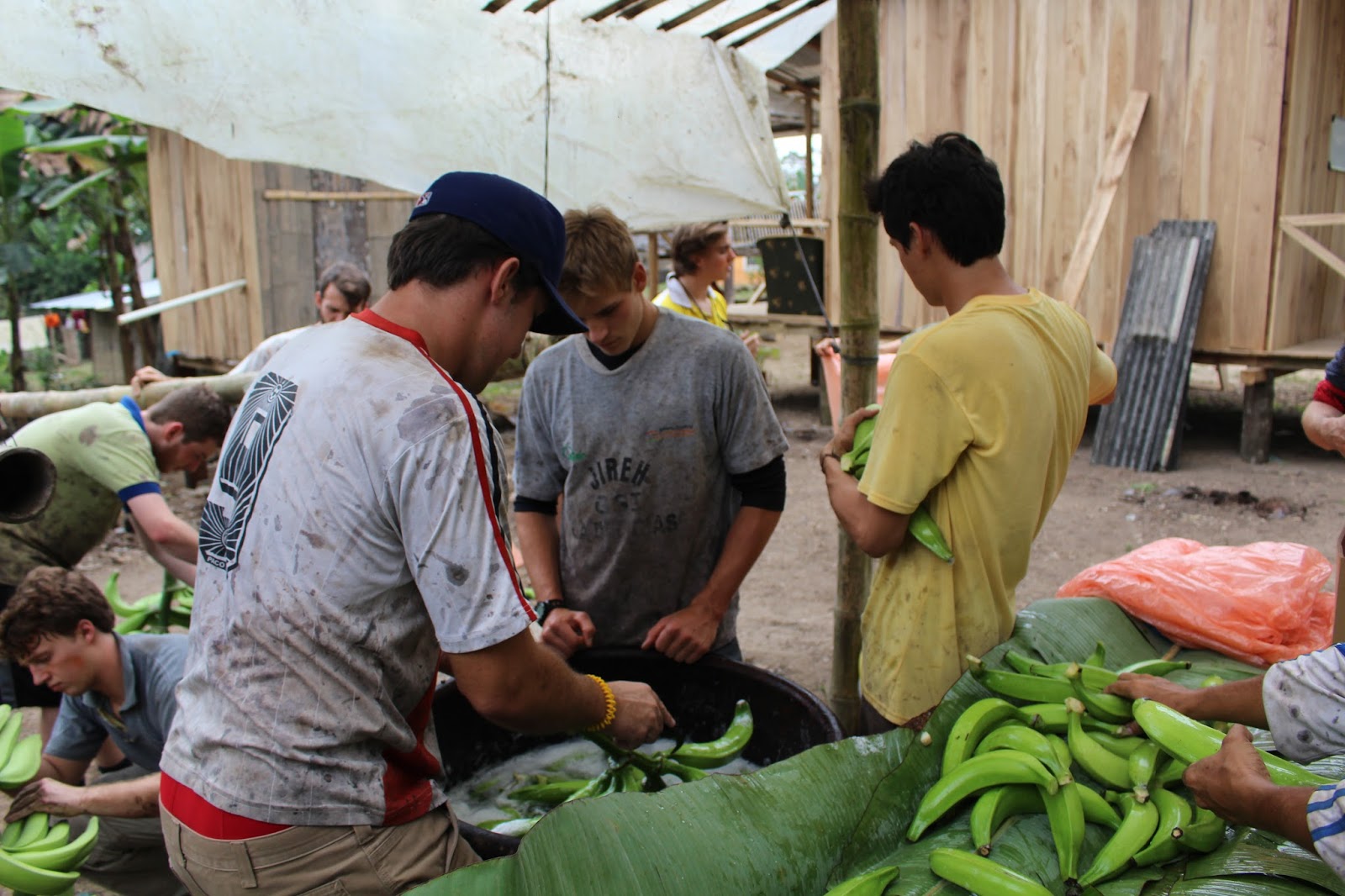
It was off to work the next morning.  We spent the better part of the day carrying, cutting, cleaning, and boxing bananas, working every part of the process from start to finish - even slapping the Dole stickers on at the end.  It was hard work, but the boost in perspective was huge.  I´ll never eat a banana unappreciatively again.

Thus began our weeklong working residence.  A typical day´s schedule included light harvest work (we also gathered other fruits, like papaya and satsuma, and slaughtered chickens, and created our own hot chocolate, from the cacao bush to the mug - all incredibly delicious, as per the town´s name); Spanish instruction (from the family members, some of whom actually work as low-level Spanish language teachers at nearby schools); downtime for hammocking (under our house, which was raised to keep the snakes out), Frisbee (most people around here have never seen one before), pickup soccer (we somehow beat the local church group 6-5 in extra time), or exploration of the area (the banana trees give way to rainforest a couple of hectares out); and miscellaneous group activities (for instance, a nightly a-capella freestyle session in the woods). I´m putting the latter in the ¨unanticipated highlights¨ category.

For most of us Carpe Diem kids, life on a working farm is something entirely new and different.  This place isn´t a huge-scale commercial produce factory, but an earnest and meager income source - and also a home.  Our host family is a modest, dedicated, and close-knit group of dawn-to-dusk laborers. It´s inspiring to live alongside them, without most of the comforts and assurances that Americans tend to take for granted.

Life improves drastically when you move to a foreign farm with no internet or smartphone access. Every hour that goes by serves to widen our perspectives and treat us to new experiences.  The farm´s laid-back agrarian lifestyle, so full yet so modest, shows what it really means to live in the moment. Spiders are everywhere, civilization is distant, and showers are provided by a rooftop rainwater urn, but I wouldn´t have it any other way; this life isn´t excessively comfortable, but it´s definitely pure.


Monday, September 21, 2015

"Hola, Soy Gringo" - Quito

If you would have told me earlier this year - say, in April - that I would spend three months of 2015 gallivanting around South America, I probably would have laughed in your face.

Yet here I am: Backpack stuffed, Spanish rusty, and water purification tablets on-hand, wrapping up my first Ecuador Week in Quito's Community Hostel and trying in vain not to fall asleep on their guest computer.  

I still don't quite know what happened in the meantime.  First, this "whole gap year thing" was an idea; then, it was a possibility; and now I'm looking back at the last hundred-some-odd hours and trying to figure out where they went and what's going on. It's been a jam-packed rush of acculturation and altitude sickness, empanadas and morocho, meditation and malaria medicine.  I've eaten traditionally-prepared cow intestines, futbolled with guayachos, saluted the sun at 10,000 feet, explored cathedrals and wandered the urban sprawl within these five or six outrageously full days. 

I might be the happiest kid in the Western Hemisphere.

Until early December I'll be living and learning with Carpe Diem Education, an accredited international volunteering organization out of Portland.  My 12 American compatriots and I are spending these 12-or-so weeks wending our way across Ecuador and Peru, volunteering in capacities as diverse as construction, conservation, and elementary education.  

That starts tomorrow, though.  This past week in the Ecuadorian capital has been our "orientation," our brief opportunity to get comfortable with this radically different part of the world.  One major objective: Practice acting just a little less American than we are. 

This is actually pretty difficult. The flagrant whiteness of our skin is enough to turn heads wherever we go, and the naturally loud demeanor of our homeland sets us well apart from the more reserved culture of the locals.  We've been stopped more than once to pose for pictures, asked all kinds of intriguing questions, and given more dead-panned stares than anybody could hope to receive in a lifetime. "Soy gringo" (literally, "I'm a white dude") has become the de facto catchphrase and conversation-starter of our group, and the earnest transparency of the statement is generally pretty well-received by locals. 

Quito's been good to us, and there's definitely a lot more to report, but I'm just too wiped-out to stay up any later. En la mañana we're heading out of the city to Las Delicias, a small family-owned banana farm on the coast. There, we're supposed to be studying some Spanish on top of helping out with the business.  They won't have internet.  I can't wait.